The Role of AI in Modern SEO Strategies
AI can help an SEO team sort information, summarize patterns and prepare a first draft, but it cannot replace evidence, subject knowledge or a clear reason for publishing a page. Use it where a person can check the inputs and output, keep factual decisions with an accountable reviewer, and measure the work against the business task. Google says the same foundational SEO practices apply to its AI search features; it describes no special AI optimization requirement. Google Search Central explains eligibility and controls for AI features.
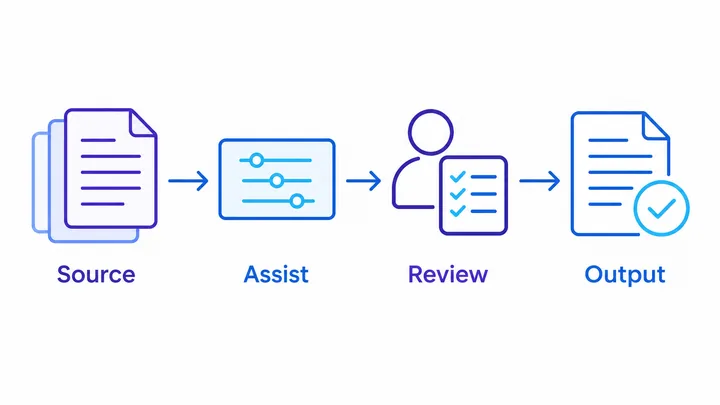
Where AI can assist an SEO workflow
SEO work includes collecting evidence, deciding which questions matter, improving pages and checking whether changes behave as intended. AI can help with repetitive language and data tasks, such as sorting a list of queries into themes, summarizing a set of page titles for review, finding recurring topics in customer questions, or turning a confirmed brief into an outline. It can also help a specialist compare two drafts or explain a technical term in plain language.
These are assistance tasks. A generated grouping does not prove that two searches have the same intent. A summary may omit an exception. A suggested title can make a claim the business has not verified. A draft is not automatically original, accurate or useful because it reads smoothly. The person using the system remains responsible for checking the result against source material and the actual site.
AI can also help people work with structured information. A reviewer might ask it to label URLs by page type, identify rows with missing metadata or summarize errors from a crawl export. Before acting, inspect representative rows and verify that the labels fit the URLs. A classification error can lead to a bad redirect, a missed page or an unnecessary new URL if it is treated as fact.
For technical investigations, use AI to help explain logs, code or a report only when the input is appropriate to share and the output can be confirmed. It may suggest plausible causes, but a plausible explanation is not a diagnosis. Check the affected URL, system configuration and direct evidence before recommending a change.
Start with a question that can be checked
A useful AI-assisted SEO task has a defined input, an output a person can inspect and a decision that remains with an accountable person. “Find themes in these customer questions” is easier to evaluate than “make our SEO better.” “Compare these page descriptions with the approved service facts” is easier to check than “write content that ranks.”
Before using a model, define:
- The decision: What will someone do with the output?
- The approved evidence: Which pages, business facts, search reports or technical records may be used?
- The output format: What labels, summary or draft will make review straightforward?
- The checks: Which facts, links, dates, calculations and edge cases must be verified?
- The stop condition: When should the system say the evidence is insufficient or refer the question to a specialist?
This keeps the task narrow enough to evaluate. For example, an AI summary of Search Console data should state the query and date range used. It should not turn impressions into visits, treat missing rows as zero demand, or claim that a position applies everywhere. A draft outline should distinguish verified information from topics that need an expert or business owner to supply facts.
Choose ordinary automation when the task is a stable rule. Sorting URLs by a known path pattern or checking whether required fields are empty may not need a language model. AI is more useful when wording varies or a person needs help exploring an unstructured collection. Compare the simplest workable method for the task rather than adding AI because it is available.
Keep content useful, accurate and accountable
AI can support research and structure, but publishing many lightly edited pages does not create value by itself. Google says generative AI may be useful for research and adding structure to original content, while generating many pages without added user value may violate its scaled content abuse policy. Its guidance on generative AI content emphasizes accuracy, quality, relevance and manual fact checking. Google’s broader spam policies describe scaled content abuse by its purpose and lack of value, regardless of whether the text was produced by automation, people or both.
That means editorial review should go beyond correcting grammar. Ask whether the page has a real audience, answers a distinct question, contributes information or analysis, and helps a reader make a decision. Check each factual statement against a reliable source. Remove invented experience, client examples, credentials, statistics, quotations, product details and guarantees. If the site cannot substantiate a claim, leave it out or ask the responsible owner to confirm it.
Make authorship and review responsibilities clear where a reader would reasonably expect them. If automation played a substantial role in creating an article, consider whether explaining that process would help readers understand how the work was produced. Do not invent a byline, professional background or first-hand experience to make AI-assisted material appear independently verified.
For businesses, an accurate article should also match the real offer and existing site structure. A guide about AI in SEO can explain a buyer’s informational question; it should not pretend that the business offers a particular software product, automated tool or guaranteed SEO result. Keep commercial service descriptions on their dedicated pages and link between them only when a reader has a clear reason to continue.
What AI features in Google Search mean for site owners
Google’s current site-owner guide says the usual SEO best practices remain relevant to AI Overviews and AI Mode, with no extra technical requirement or special optimization needed for those features. A page must be indexed and eligible to appear with a snippet in Search to be eligible as a supporting link, but eligibility does not guarantee crawling, indexing or display. Read Google’s AI features guidance for the current requirements and controls.
Practical fundamentals still matter: make important pages accessible to crawlers, ensure the intended content is available in text, use clear internal links, provide a good page experience and keep structured data consistent with visible content. Google’s technical requirements explain the basic access, successful page response and indexable-content conditions. Its link guidance explains how descriptive links help people and Google understand destinations.
Do not confuse appearing in an AI search feature with a controllable SEO deliverable. A consultant cannot promise that a page will be selected, cited or shown in a particular AI response. Search features and their links vary, and a page that meets eligibility requirements may still not be served. Evaluate work through observable site quality and the search data available to the business, not a guaranteed AI Overview placement.
For measurement, Google says traffic from AI features is included in the overall Search Console Web performance data. That makes it important to define the source, report and period before drawing conclusions. A click is a site visit; it does not by itself establish a qualified lead or sale. If analytics or downstream sales data is missing, keep attribution unknown rather than filling the gap with an estimate.
Use a review process that catches predictable errors
A reliable review begins with the source material. Ask the AI to work from approved pages, documents or data rather than relying on an unsourced recollection. Then check claims against the original source, including numbers, dates, product names, links and legal or policy statements. A citation suggested by a model is only a lead until the reviewer opens and confirms the source.
Review structure and usefulness separately from factual accuracy. A correct list can still be repetitive or confusing. A fluent explanation can miss the reader’s central question. Check that the opening answers the intent, headings describe the content, examples are real or clearly labeled as hypothetical, and the next step is appropriate. Ask a knowledgeable person to review specialized claims.
Protect information before it enters a service. Do not paste passwords, customer records, private analytics exports or confidential project details into a tool unless its terms and approved data-handling process allow that use. Remove identifiers when they are not required. Consider whether the provider stores prompts or uses submissions to improve its service, and follow the organization’s security and privacy rules.
Keep a human responsible for publication and implementation. This person should know what was generated, what evidence was checked, which recommendations were accepted and what remains uncertain. For technical changes, use the normal review and rollback process. For public content, check the rendered page, links, metadata, images and schema rather than assuming a correct draft guarantees a correct release.
A practical workflow for using AI in SEO
- Define the business question. Identify the customer, page or technical decision and the outcome the business can observe.
- Gather approved evidence. Use the actual site inventory, verified service information and relevant search or technical data. Record the source and date.
- Ask for a bounded assist. Request a summary, categorization, comparison or draft that is easy to inspect. Tell the tool to flag missing evidence instead of guessing.
- Verify the output. Open referenced pages, validate links and values, test edge cases and ask the content or technical owner to review specialized decisions.
- Apply only approved changes. Keep the scope, owner and rollback plan clear. Check the rendered page or affected route after implementation.
- Measure what changed. Record the period and data source. Distinguish search visibility, site engagement, inquiries and sales.
This process also creates a record of why AI was used and where human judgment entered. It helps a team repeat useful work while spotting cases where the output was wrong or the task would have been simpler with a rule, spreadsheet or direct review.
AI can make a capable SEO workflow more efficient, but the important work remains deciding what evidence matters, interpreting it honestly and serving the reader. Google’s advice on helpful, reliable, people-first content is a useful editorial check: would the intended audience find this material helpful if they came to the site directly?
Keep the SEO and software questions distinct
This article is an informational guide to AI-assisted SEO work. It does not describe a proprietary SEO tool or promise that AI will improve rankings. A business that needs help with site strategy can explore SEO services or the more focused local SEO service. Those pages cover separate service decisions.
A business evaluating an AI-enabled application for an internal task has a different buying question. The coordinated AI software development page discusses business workflows, data, review and software scope. A business should use that page to assess an application project, not infer from this article that an AI product or SEO automation tool already exists.
Web Design Plus SEO is based in Doral, Florida and delivers services remotely nationwide. To discuss an SEO project, use the existing contact route and describe your site, business question and evidence available. Do not submit passwords or private customer information through a public form.



